
Views, Filters & Print
Types of Tracking Layouts
Types of tracking layouts is four types: Project Table, Project Bar Chart, Project Gantt/Profile, Resource Analysis
What a planner means
Types of tracking layouts is Oracle Types of tracking layouts. Four types: Project Table, Project Bar Chart, Project Gantt/Profile, Resource Analysis. It is a how-to (a catalog page). It is not stored as its own table. It does not create, edit, or delete a relationship. It is not the Tracking object note, not Open a tracking layout, not Create a Project Table, not Activities Show on Bottom, not Resource Usage Profile, not EPPM copied onto Professional, and not Microsoft Project view types.
Oracle does print a how-to titled Types of tracking layouts. Oracle does not print a menu item named Types of tracking layouts. This page prints no menu path. Do not invent View > Types of tracking layouts.
Oracle Types of tracking layouts (Professional):
- "You can create four types of tracking layouts:"
- "Project Table: displays project data in a table."
- "Project Bar Chart: displays project data in a horizontal bar chart."
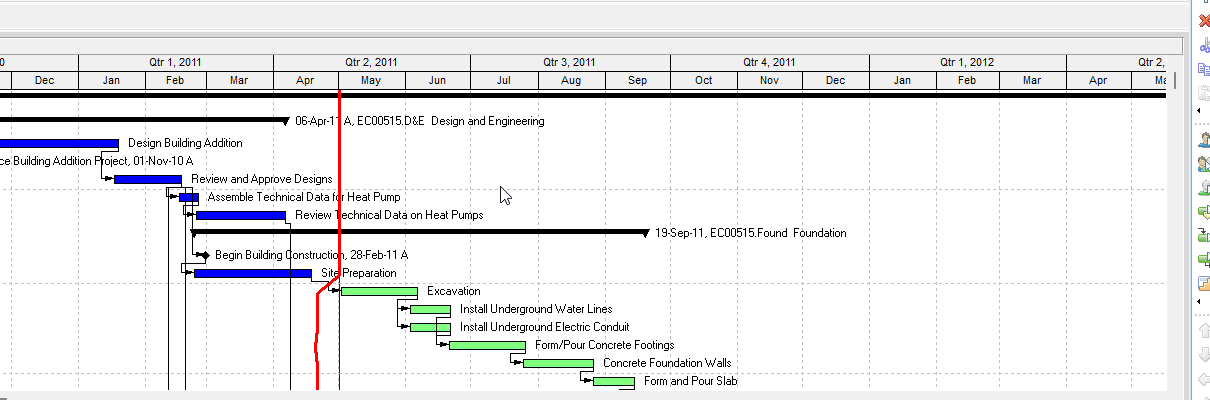
- "Project Gantt/Profile: displays project information in columns and a Gantt Chart in the Top Layout window and as time-distributed project data in spreadsheet or profile in the Bottom Layout window."
- "The Bottom Layout window also includes column data when you display a spreadsheet."
- "Resource Analysis: displays time-distributed resource usage information in three formats: Gantt Chart, profile, and spreadsheet."
- "When you display the Gantt Chart or spreadsheet, the Layout window also includes column data in the left pane."
- "You can use a Resource Analysis layout to examine resource allocation for one or more specific projects and/or total allocation for all projects across the enterprise."
This page fetched prints those four type names in the singular. The Tracking object note quotes a different page that prints Project Bar Charts, Project Gantt/Profiles, Project Tables, and Resource Analyses. Quote both. Do not invent which wording wins.
This page prints Layout window on the Resource Analysis sentence and Top Layout window / Bottom Layout window on the Project Gantt/Profile sentences. Quote both. Do not invent that they are the same pane.
That how-to fetched prints no OK, Apply, Cancel, Save, or Yes. It prints no create-layout steps. Do not invent those on this how-to.
The Tracking window is a different object note. Leave Tracking as the object.
Open a tracking layout is a different how-to. View, Layout, Open. Do not collapse this catalog onto that path. See Open a Tracking Layout.
Professional vs EPPM
Professional — four types as printed: Project Table, Project Bar Chart, Project Gantt/Profile, Resource Analysis.
EPPM web — the Professional how-to page is the source for this note. Do not invent an EPPM Types of tracking layouts dialog. Do not copy Professional four types onto EPPM.
Primavera Cloud is a different product. Do not copy it here.
XER
The how-to is not an XER table. Oracle’s project XER map TOC has no TRACKING / TRACK / LAYOUT table. Do not invent a view %T. Naming the four types does not write TASK. Layouts travel as .plf. PROJISSU.track_view_id and PROJTHRS.track_view_id are labeled Tracking Layout — a pointer on the issue/threshold, not the layout definition. A Viewer cannot reconstruct that the planner used this how-to.
Microsoft Project
Microsoft Project has Gantt, Usage, and Resource views. Do not map those as P6 Types of tracking layouts. Do not claim MPXJ writes a real MPP.
Don't
- Invent View > Types of tracking layouts, OK, Apply, Cancel, Save, Yes, or create-layout steps on this page.
- Collapse this onto the Tracking object, Open a tracking layout, or a Create Project Table / Bar Chart / Gantt/Profile / Resource Analysis how-to.
- Copy Professional four types onto EPPM.
- Invent a TRACKING / LAYOUT XER table, or reconstruct the how-to from TASK or track_view_id.
- Map MSP view types as this how-to.
- Claim MPXJ writes a real MPP.