
In Primavera P6
View Activity Relationships in the Activity Table
View activity relationships in the Activity Table is Predecessor Details / Successor Details columns
What a planner means
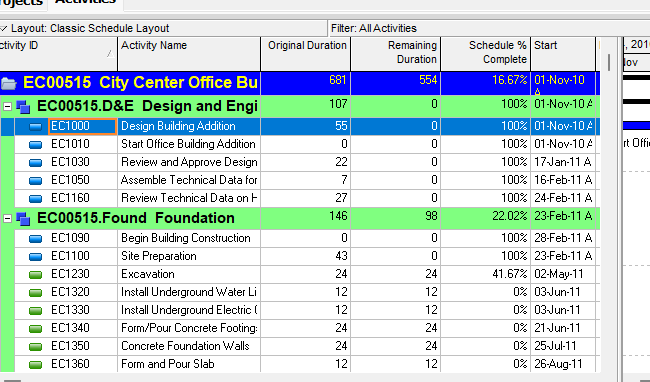
View activity relationships in the Activity Table is Oracle View activity relationships in the Activity Table. View, Columns (or Layout Options bar → Columns). Select Predecessor Details and/or Successor Details in the Available Columns section, then click. It is a how-to. It is view. It does not create, edit, or delete a relationship. It is not stored as its own table. It is not Columns as the layout object, not Define Activity Table columns, not The Activity Table / Show on Top Table, not Change activity information in the Activity Table, not Assign Predecessors / Assign Successors, not Add predecessor / Add successor, not Change predecessor / Change successor, not View activity relationships in Activity Details, not View activity relationships in the Gantt Chart, not View activity relationships in the Activity Network, not View activity relationships in Trace logic, not EPPM Lists Columns / Configuring Activity View Columns copied onto Professional, and not Microsoft Predecessors / Successors (task field).
Oracle does print a how-to titled View activity relationships in the Activity Table. The client-help file name is view_activity_relationships_in_activity_details.htm. Quote the title, not the file name. That file is this Activity Table how-to. View activity relationships in Activity Details is 19567.htm. Do not collapse the file name onto the Details title. Oracle does not print a menu item named View activity relationships in the Activity Table. Do not invent View > View activity relationships in the Activity Table.
Oracle View activity relationships in the Activity Table (Professional):
- "The Activity Table enables you to view the open project's activity information in table format."
- "Choose View, Columns." "You can also click the Layout Options bar and choose Columns."
- "To view information about predecessors, select Predecessor Details in the Available Columns section, then click."
- "To view information about successors, select Successor Details in the Available Columns section, then click."
Quote those. Quote Predecessor Details, Successor Details, Available Columns section, and then click. That how-to fetched prints no button name on "then click," no Available Options, no Lists grouping, no relationship type, no lag, no Comments, no Assign, no Double-click, no Show on Top, no Show on Bottom, no Save, no comma-separated list, no SS / SF / FS / FF codes, no Activity ID format, no read-only, no Predecessors / Successors columns (without Details), and no menu item named View activity relationships in the Activity Table. Do not invent those on this how-to.
Oracle Add predecessor relationships tip (different page): "You can add the Predecessor Details column to the Activity Table to see a list of all predecessors, the relationship type, and the lag applied to the relationship." Oracle Add successor relationships tip (different page): "You can add the Successor Details column to the Activity Table to see a list of all successors, the relationship type, and the lag applied to the relationship." Quote those tips on Add predecessor / Add successor, not on this view how-to. This view how-to fetched prints no "list of all predecessors" / "relationship type" / "lag applied" sentence.
Columns is a different object. Oracle Columns dialog: "Use the Columns dialog box to specify which columns you want to display and their order." That page labels the pick list Available Options. This how-to names two fields in the Available Columns section. Define Activity Table columns uses the same View, Columns / Layout Options bar path for any column. This how-to is specifically Predecessor Details / Successor Details. See Columns.
The Activity Table is a different object. Oracle The Activity Table: "Use the Activity Table to view the open project's activity information in table format." Top Layout toolbar: View > Show on Top > Table. This view-relationships how-to fetched prints no Show on Top and no Table. Do not collapse opening the table onto adding these two columns.
Change activity information in the Activity Table is a different how-to. Oracle: "To change activity information, double-click the information you want to change." This view how-to fetched prints no Double-click. See Edit Activity.
Assign Predecessors / Add predecessor relationships are different commands. Edit > Assign > Predecessors / Details Assign. Those create a relationship. This views columns. See Assign Predecessors and Assign Successors.
Change predecessor / Change successor are different how-tos. Details tab double-click Relationship Type / Lag / Remove. See Change Predecessor Relationships and Change Successor Relationships.
View activity relationships in Activity Details is a different how-to. Select the activity → Layout Options bar → Show on Bottom, Activity Details → Predecessors or Relationships tab (predecessors) / Successors or Relationships tab (successors). That is tabs, not table columns. See View Activity Relationships in Activity Details.
View activity relationships in the Gantt Chart is a different how-to. Layout Options bar → Show on Top, Gantt Chart. Line connecting two activity bars. See View Activity Relationships in the Gantt Chart.
View activity relationships in the Activity Network is a different how-to. Hierarchy table on the left; line connecting two activity boxes. See View Activity Relationships in the Activity Network.
View activity relationships in Trace logic is a different how-to. Select the activity → Layout Options bar → Show on Bottom, Trace Logic. "Trace Logic displays a graphical view of only the selected activity's relationships." Blue border; left = predecessors; right = successors. That is selected-activity Show on Bottom, not these table columns. See Trace Logic.
Oracle Viewing activity relationships lists five separate how-tos: Activity Table, Activity Details, Gantt Chart, Activity Network, Trace logic. Do not collapse those titles.
Oracle Activities window Working with activity relationships names View activity relationships in Activity Details, the Activity Network, the Gantt Chart, and Trace logic. It does not name View activity relationships in the Activity Table. Working with the Activity Table names Define Activity Table columns and Change activity information in the Activity Table. It does not name this view how-to. Linking Activities with Relationships lists Create / Edit / Delete Gantt and Network. It does not list the View how-tos. Do not invent that those pages listed this title.
Add/Edit/Delete Activity Relationships privilege (Professional project profile): "Determines whether the profile will enable users to create, modify, and remove activity relationships assigned to projects." The View activity relationships in the Activity Table how-to fetched does not print that privilege. Do not invent that it did.
Professional vs EPPM
Professional — View, Columns / Layout Options bar → Columns; select Predecessor Details / Successor Details in the Available Columns section, then click. That page fetched prints no Save, no comma-separated list, no SS / SF / FS / FF, no "If lag duration is zero, it is not shown," no Lists category, and no Predecessors / Successors fields (without Details).
EPPM web — do not copy Professional View, Columns / Available Columns section / then click onto EPPM. Do not invent that EPPM prints a how-to titled View activity relationships in the Activity Table.
Oracle EPPM Lists Columns of the Activity Table / Available Columns of the Activities Page Lists category (G48897) is field help, not this Professional how-to. Predecessor Details field: "The activities required to start or finish before the activity starts or finishes, including the relationship types and lags applicable to the relationships. The column shows a comma separated list of the IDs of the predecessor activities, their relationship types (as "SS", "SF", "FS" or "FF") and the duration of any lag applied to the relationships. If lag duration is zero, it is not shown." Sucessor Details field (Oracle's spelling on that page): the successor counterpart of that sentence. Those pages also name Predecessors field and Successors field (no Details): "The activities required to start or finish before [after] the activity starts or finishes, depending on the relationship type." Those pages fetched print no View, Columns, no Layout Options bar, and no Available Columns section / then click. Do not invent that they did. Do not copy EPPM comma-separated / "SS", "SF", "FS" or "FF" / zero-lag-not-shown / Predecessors field / Sucessor Details spelling onto Professional.
Oracle EPPM Configuring Activity View Columns: Customize View → Columns tab; "Customize the Selected Columns list using values from the Available Columns list." "Click Save and Apply." "You can display a maximum of 30 columns." "You can customize activity view columns from the View menu. Click the View menu and select Columns." That page fetched prints no Predecessor Details, no Successor Details, and no this Professional how-to. Do not invent that it did. Do not copy Save and Apply / 30-column max onto Professional.
Primavera Cloud is a different product. Do not copy it here.
XER
The how-to is not an XER table. Adding Predecessor Details / Successor Details columns does not write TASKPRED. Oracle's project XER map TOC has no VIEWTABLE / VIEWREL / TABLEREL / VIEW_TABLE_RELATIONSHIP table. Do not invent a view %T. Do not treat a TASKPRED row as "the planner used View activity relationships in the Activity Table."
TASKPRED is the relationship. Columns that match names Oracle used elsewhere (Oracle XER labels): pred_type (Relationship Type), lag_hr_cnt (Lag), comments (Comments), task_id (Successor), pred_task_id (Predecessor). The View activity relationships in the Activity Table how-to fetched does not print those column names. See TASKPRED (Activity Relationships).
Layouts travel as .plf, not in a project XER. The Columns dialog is a layout setting. See Columns and Filters and Layouts Are a View, Not the Schedule.
A Viewer parse of one XER cannot reconstruct whether the planner used this Activity Table how-to, Activity Details tabs, Gantt lines, Network boxes, Trace Logic, or EPPM Lists Columns.
Microsoft Project
Desktop Project has Predecessors and Successors task fields. They are not the same object.
Microsoft Predecessors (task field): "The Predecessors field lists the task ID numbers for the predecessor tasks on which the task depends before it can be started or finished." "Add the Predecessors field to a task view when you want to display or update task predecessors." "Each predecessor task is represented by its task ID number, which may be followed by a dependency type and the lead or lag time. The dependency types for predecessors are FS (finish-to-start), FF (finish-to-finish), SS (start-to-start), and SF (start-to-finish)." Example: "14FS+3d". "If you enter only the task ID number in the Predecessors field, Project assumes a finish-to-start dependency with zero lag time. If there is more than one predecessor, they are all listed and separated by the list-separator character, which is typically the comma or semicolon."
Microsoft Successors (task field): "The Successors field lists the task ID numbers for the successor tasks to a task." "Add the Successors field to a task sheet when you want to display or update task successors." Same FS / FF / SS / SF and list-separator remarks.
Microsoft Link tasks in a project (Project Online subscriber): "you can also select specific tasks to link to using a drop-down box from the Predecessors or Successors column." "The Successor column is not shown by default. To show it, go to the last column in the row, and select Add New Column. Choose Successors."
Quote Predecessors field, Successors field, display or update, 14FS+3d, and Add New Column. P6 printed Predecessor Details / Successor Details, View, Columns, Available Columns section, and then click. Do not collapse them. Microsoft pages fetched print no View, Columns, no Layout Options bar, no Predecessor Details, and no Successor Details. Do not invent that they did. They are not the same command as P6 View activity relationships in the Activity Table. Do not map P6 Predecessor Details / Successor Details to MSP Predecessors / Successors as the same how-to. Do not claim MPXJ writes a real MPP.
Don't
- Treat this as Columns, Define Activity Table columns, The Activity Table / Show on Top Table, Change activity information in the Activity Table, Assign / Add / Change, View Details, View Gantt, View Network, or View Trace logic.
- Invent relationship type, lag, Comments, Assign, Double-click, Show on Top, Save, a button name on "then click," Lists grouping, comma-separated list, SS / SF / FS / FF codes, Activity ID format, read-only, Predecessors / Successors columns (without Details), or a menu item named View activity relationships in the Activity Table on this how-to.
- Invent that this how-to printed "a list of all predecessors, the relationship type, and the lag" (that sentence is the Add predecessor tip).
- Collapse the file name
view_activity_relationships_in_activity_details.htmonto View activity relationships in Activity Details (19567.htm). - Invent that Activities window Working with activity relationships or Linking Activities with Relationships listed this View how-to.
- Invent that the view how-to printed Add/Edit/Delete Activity Relationships.
- Copy Professional View, Columns / Available Columns section / then click onto EPPM, or copy EPPM comma-separated / "SS", "SF", "FS" or "FF" / zero-lag-not-shown / Predecessors field / Sucessor Details spelling / Save and Apply / 30-column max onto Professional.
- Invent that EPPM prints a how-to titled View activity relationships in the Activity Table.
- Invent a VIEWTABLE / VIEWREL / TABLEREL / VIEW_TABLE_RELATIONSHIP XER table, or treat a TASKPRED row as "the planner used View activity relationships in the Activity Table."
- Claim a Viewer reconstructed that the planner last used this Activity Table how-to from an XER.
- Map P6 View activity relationships in the Activity Table to MSP Predecessors / Successors (task field) / Link tasks drop-down as the same how-to.
- Invent that Microsoft printed Predecessor Details / Successor Details or View, Columns.
- Claim MPXJ writes a real MPP.
Sources
- Oracle View activity relationships in the Activity Table [27 Aug 2026]
- Oracle same how-to [27 Aug 2026]
- Oracle Viewing activity relationships [27 Aug 2026]
- Oracle View activity relationships in Activity Details [27 Aug 2026]
- Oracle View activity relationships in the Gantt Chart [27 Aug 2026]
- Oracle View activity relationships in the Activity… [27 Aug 2026]
- Oracle View activity relationships in Trace logic [27 Aug 2026]
- Oracle Add predecessor relationships [27 Aug 2026]
- Oracle Add successor relationships [27 Aug 2026]
- Oracle Columns dialog box [27 Aug 2026]
- Oracle Define Activity Table columns [27 Aug 2026]
- Oracle The Activity Table [27 Aug 2026]
- Oracle Top Layout toolbar [27 Aug 2026]
- Oracle Change activity information in the Activity Table [27 Aug 2026]
- Oracle Activities window [27 Aug 2026]
- Oracle Linking Activities with Relationships [27 Aug 2026]
- Oracle Project Privilege Definitions [27 Aug 2026]
- Oracle Lists Columns of the Activity Table [27 Aug 2026]
- Oracle Available Columns of the Activities Page [27 Aug 2026]
- Oracle Configuring Activity View Columns [27 Aug 2026]
- Oracle XER project map TOC [27 Aug 2026]
- Oracle XER TASKPRED [27 Aug 2026]
- Oracle Exporting and Importing Layouts [27 Aug 2026]
- Microsoft Predecessors (task field) [27 Aug 2026]
- Microsoft Successors (task field) [27 Aug 2026]
- Microsoft Link tasks in a project [27 Aug 2026]
- Related [27 Aug 2026]