
In Primavera P6
View Activity Relationships in Trace Logic
View activity relationships in Trace logic is Show on Bottom selected-activity boxes; not the Trace Logic view object
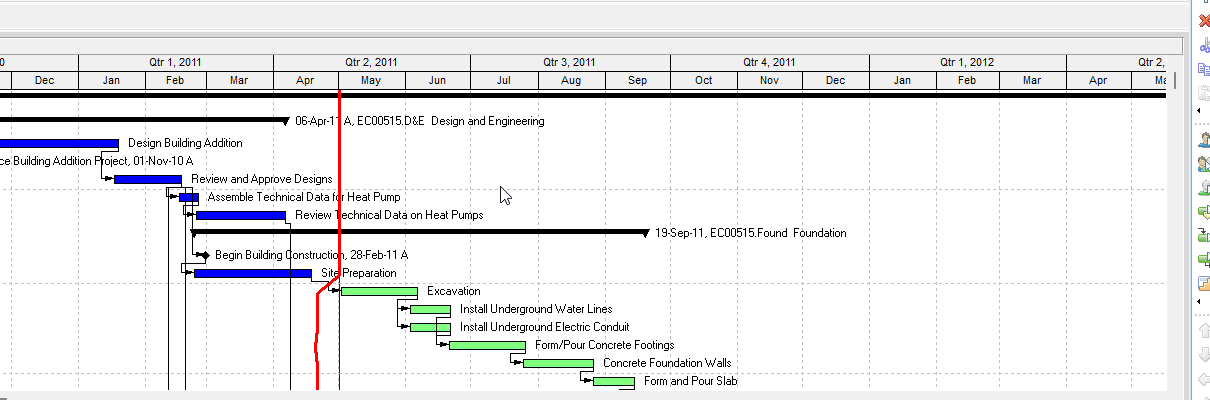
What a planner means
View activity relationships in Trace logic is Oracle View activity relationships in Trace logic. Layout Options bar → Show on Bottom, Trace Logic. "Trace Logic displays a graphical view of only the selected activity's relationships." It is a how-to. It is view. It is not stored as its own table. It does not create, edit, or delete a relationship. It is not the Trace Logic view object, not Display Trace Logic, not Set Trace Logic preferences, not Move around in Trace Logic, not View activity relationships in the Gantt Chart, not View activity relationships in the Activity Network, not View activity relationships in Activity Details, not View activity relationships in the Activity Table, not Display the Activity Network, not the Activity Network view, not Show Relationships, not Assign Predecessors, not Assign Successors, not Add predecessor relationships, not Add successor relationships, not Change predecessor relationships, not Change successor relationships, not Remove predecessor relationships, not Remove successor relationships, not TASKPRED, not EPPM About Trace Logic / Trace Logic Detail Window / Viewing Relationships with Trace Logic copied onto Professional, and not Microsoft Task Path, Task Inspector, or Network Diagram.
Oracle does print a how-to titled View activity relationships in Trace logic. Oracle does not print a menu item named View activity relationships in Trace logic. Do not invent View > View activity relationships in Trace logic.
Oracle View activity relationships in Trace logic (Professional):
- "Trace Logic displays a graphical view of only the selected activity's relationships."
- "Select the activity whose relationships you want to view."
- "Click the Layout Options bar, then choose Show on Bottom, Trace Logic."
- "The selected activity appears with a blue border. Activity boxes to the left of the selected activity are predecessors. Activity boxes to the right of the selected activity are successors."
Quote those. Quote Layout Options bar, Show on Bottom, Trace Logic, only the selected activity's relationships, blue border, Activity boxes to the left, predecessors, Activity boxes to the right, and successors. That how-to fetched prints no "Choose Project, Activities,", no View > Show on Bottom > Trace Logic, no Bottom Layout toolbar, no "With the Activities window active", no red border, no critical, no "A line connecting activity boxes indicates an activity relationship", no step forward or backward, no lower layout / upper layout, no Activity Table / Activity Network / Activity Usage spreadsheet / Gantt Chart as the place you select, no "boxes display the same information as the current Activity Network layout", no Zoom, no Bottom Layout Options, no number of predecessors / successors, no Apply, no Display Options bar, no driving / non-driving, no solid vs dashed, no Assign, no Remove, no Go To, no Double-click, no Relationship Type, no Lag, no Comments, no finish to start / finish to finish / start to start / start to finish, no FS / FF / SF / SS codes, no hierarchy table, no four begins-on / ends-on sentences, no activity bars, no Predecessor Details / Successor Details, no Predecessors or Relationships tab, no privilege, no Save, no Yes, no OK, and no menu item named View activity relationships in Trace logic. Do not invent those on this how-to.
The Trace Logic view object is a different page. Oracle Trace Logic: it "enables you to step forward or backward through a sequence of activities to focus on predecessor/successor relationships." It is "displayed in the lower layout" and "represents relationships for an activity you select in the Activity Table, Activity Network, Activity Usage spreadsheet, or Gantt Chart currently displayed in the upper layout." "A red border around an activity box indicates a critical activity." "A line connecting activity boxes indicates an activity relationship." Use the layout to "Examine an activity and its predecessors and successors" and "Determine why an activity is scheduled at a particular time" (delayed predecessors, obsolete constraint, SS vs FS, negative float). Zoom: "Zoom in or out without affecting the level of detail displayed in the upper layout." Bottom Layout Options / Display Options bar: "specify how many levels of predecessors and successors you want to view." This view how-to fetched prints none of those sentences. It is view of the selected activity's boxes. Do not copy the object page onto this how-to. See Trace Logic.
Display Trace Logic is a different how-to. "With the Activities window active, do one of the following:" Bottom Layout toolbar; View, Show on Bottom, Trace Logic; Layout Options bar and choose Show on Bottom, Trace Logic. Note: "The activity boxes in Trace Logic display the same information as the boxes defined for the current Activity Network layout." This view how-to prints Layout Options bar → Show on Bottom, Trace Logic only. It fetched prints no "With the Activities window active", no Bottom Layout toolbar, no View, Show on Bottom, Trace Logic, and no boxes-equal-Activity-Network-layout note. Opening the bottom layout is not this view. Do not collapse them.
Set Trace Logic preferences is a different how-to. "You can specify the number of activity relationships you want to display in Trace Logic." View, Bottom Layout Options (or Layout Options bar → Bottom Layout Options). "Specify the number of predecessors you want to display." "Specify the number of successors you want to display." Apply "To preview your changes." This view how-to fetched prints no Bottom Layout Options, no number of predecessors / successors, and no Apply. Setting levels is not this view.
Move around in Trace Logic is a different how-to. "To view an activity's relationships in Trace Logic, click the activity in the Activity Table, Gantt Chart, Activity Usage Spreadsheet, Activity Network, or Trace Logic window." This view how-to prints "Select the activity whose relationships you want to view" then Layout Options bar. It fetched prints no those upper-layout names and no "Trace Logic window." Clicking another box after the layout is open is not this how-to.
View activity relationships in the Gantt Chart is a different how-to. Layout Options bar → Show on Top, Gantt Chart. "A line connecting two activity bars indicates an activity relationship." Four begins-on / ends-on activity's bar sentences. That is bars, not selected-activity Show on Bottom boxes. See View Activity Relationships in the Gantt Chart.
View activity relationships in the Activity Network is a different how-to. Hierarchy table on the left; "A line connecting two activity boxes indicates an activity relationship." Four begins-on / ends-on predecessor's box / successor's box sentences. That is Show-on-Top boxes for a filter, not "only the selected activity's relationships." See View Activity Relationships in the Activity Network.
View activity relationships in Activity Details is a different how-to. Layout Options bar → Show on Bottom, Activity Details. Predecessors or Relationships tab / Successors or Relationships tab. That is tabs, not Trace Logic boxes. See View Activity Relationships in Activity Details.
View activity relationships in the Activity Table is a different how-to. View, Columns (or Layout Options bar → Columns) → Predecessor Details / Successor Details. That is Activity Table columns, not Trace Logic boxes. See View Activity Relationships in the Activity Table.
Display the Activity Network is a different how-to. View > Show on Top > Activity Network / Layout Options bar / Top Layout toolbar. That opens the Network. This how-to is Show on Bottom, Trace Logic. Do not collapse them.
The Activity Network view is a different object. Show-on-Top WBS diagram. "A line connecting activity boxes indicates an activity relationship." You can "Combine the Activity Network with a Trace Logic layout to focus on a specific sequence of activities." Box positions save as .ANP. That object page is not this view how-to. See Activity Network.
Show Relationships is a different command. Bar Chart Options / Top Layout toolbar Gantt relationship-line show/hide. See Show Relationships.
Assign Predecessors / Add predecessor relationships is a different command. Edit > Assign > Predecessors / Details Assign / Assign Predecessors dialog. That page prints Assign, Select Project, Relationship Type / Lag / Comments. This page is view. It does not print Assign. See Assign Predecessors.
Assign Successors / Add successor relationships is a different command. Edit > Assign > Successors / Details Assign / Assign Successors dialog. This page does not print Assign. See Assign Successors.
Change predecessor relationships / Change successor relationships are different how-tos. Display Activity Details; Assign / double-click Relationship Type / double-click Lag / Remove. This page fetched prints no those actions. See Change Predecessor Relationships and Change Successor Relationships.
Remove predecessor relationships / Remove successor relationships are different how-tos. Details Remove → Yes; those pages name Go To. This page fetched prints no Remove, no Yes, and no Go To.
Oracle Viewing activity relationships lists five separate how-tos: Activity Table, Activity Details, Gantt Chart, Activity Network, Trace logic. Do not collapse those titles.
Oracle Activities window Working with activity relationships names View activity relationships in Trace logic as a separate task from Add / Change / Remove predecessor and successor, Create / Edit / Delete Gantt and Network, View Gantt, View Network, and View Activity Details. That list does not name View activity relationships in the Activity Table. Working with Trace Logic names Display Trace Logic, Move around in Trace Logic, Set Trace Logic preferences, and View activity relationships in Trace logic as separate tasks. Do not collapse those titles.
Oracle Linking Activities with Relationships lists Create / Edit / Delete Gantt and Network. It does not list the View how-tos. Do not invent that it did.
Oracle View Menu Show on Bottom: "Enables you to choose the type of layout you want to display in the bottom portion of the active window. The available options correspond to the currently active window." Corresponding toolbar: Bottom Layout Toolbar. Bottom Layout Options: "Enables you to customize the tabs that display in Activity Details." Enabled when the active window is Activities. Corresponding toolbar: None. Those rows fetched print no menu item named View activity relationships in Trace logic. Do not invent one. Do not collapse View Menu Bottom Layout Options (Activity Details tabs) onto Set Trace Logic preferences View, Bottom Layout Options (predecessor / successor counts). This how-to prints neither.
Oracle Bottom Layout Toolbar: "Shows or hides Trace Logic in the bottom layout." Enabled when active window is Activities. Corresponding menu: View > Show on Bottom > Trace Logic. That toolbar page fetched prints no View activity relationships in Trace logic. Do not invent that it did. This how-to fetched prints no Bottom Layout toolbar and no View > Show on Bottom > Trace Logic.
Add/Edit/Delete Activity Relationships privilege (Professional project profile): "Determines whether the profile will enable users to create, modify, and remove activity relationships assigned to projects." The View activity relationships in Trace logic how-to fetched does not print that privilege. Do not invent that it did.
The Professional View Trace logic how-to fetched does not print driving / non-driving, solid vs dashed, critical relationship lines, a red border, a line-style / color picker, milestone diamond, status icons, or Standard View box sentences. Do not invent them.
Professional vs EPPM
Professional — the how-to above. Layout Options bar → Show on Bottom, Trace Logic. Selected activity blue border. Left = predecessors. Right = successors. "only the selected activity's relationships." That page fetched prints no Save, no View > Show on Bottom > Trace Logic, no Bottom Layout toolbar, no red border, no line connecting boxes, no Bottom Layout Options levels, no driving / non-driving, and no Trace Logic detail window.
EPPM web — do not copy Professional Layout Options bar / Show on Bottom, Trace Logic / "only the selected activity's relationships" / blue border onto EPPM.
Oracle EPPM About Trace Logic (G48897): "a graphical display of dependency relationships for an activity." "This alternative viewing format enables you to examine a path of relationships while still viewing the entire project." Selected activity "highlighted in blue." "Activity boxes with a red border represent critical activities." Left = predecessors; right = successors. "Solid lines represent driving relationships, while dashed lines represent non-driving relationships." You "view activity relationships in the Trace Logic detail window"; you "manage activity relationships using the detail windows or Gantt chart." Schedule questions (delayed predecessors, obsolete constraint, SS vs FS, negative float). That page fetched does not print Layout Options bar, Show on Bottom, Trace Logic, or "only the selected activity's relationships." Do not invent that it did. Do not invent that Professional printed highlighted in blue, red border, solid / dashed, driving / non-driving, Trace Logic detail window, or those schedule questions on this how-to.
Oracle EPPM Trace Logic Detail Window of the Activities Page (G48897): "Use this detail window to view activity relationships using trace logic." Getting Here: Navigation Menu → Projects → Activities; select an activity; click the Trace Logic detail window. Predecessor Levels / Successor Levels: "The number of predecessor [successor] levels to show for the selected activity." Zoom In, Zoom Out, Zoom to 100%, Zoom to Fit. "The selected box has a heavy blue border." "Activity boxes outlined in red are critical activities." "Solid red lines between boxes represent critical relationships." "Solid lines represent driving relationships, while dashed lines represent non-driving relationships." "Boxes with a black diamond in the corner represent milestones." "A status icon in the corner of the box identifies In Progress, Completed, and Critical activities." Boxes show "Activity Name, Activity ID, Start Date and Finish Date." "You cannot customize activity boxes in Standard View." Tip: "If you have more than one activity or a grouping band selected, the detail window will not be visible." That page fetched does not print Layout Options bar, Show on Bottom, Trace Logic, or "The selected activity appears with a blue border." Do not invent that it did. Do not invent that Professional printed Trace Logic detail window, heavy blue border, Predecessor Levels / Successor Levels, Zoom to Fit, solid red critical relationship lines, milestone diamond, status icons, Standard View, or hidden if more than one activity.
Oracle EPPM Viewing Relationships with Trace Logic (G48897): "Use trace logic to follow activity relationships throughout a project." Projects → Activities; select an activity; click the Trace Logic detail window. "The selected activity is shown with its predecessor and successor activities." "Click another activity in the detail window to see its connections to predecessor and successor activities." Tips: drag the top edge upward to enlarge; "You can click and drag the detail window contents." That page fetched does not print Layout Options bar, Show on Bottom, Trace Logic, blue border, or left = predecessors / right = successors. Do not invent that it did. Do not invent that Professional printed Trace Logic detail window, click another activity, or drag-to-enlarge.
Primavera Cloud is a different product. Do not copy Cloud Trace Logic onto P6 Professional or EPPM.
XER
None. Oracle's project XER map TOC has no VIEWTRACE / VIEWREL / TRACE / TRACELOGIC / TRACE_LOGIC / VIEW_TRACE_RELATIONSHIP / VIEWRELATIONSHIP table. This how-to does not write TASKPRED. Do not invent a view %T. Do not treat a TASKPRED row as "the planner used View activity relationships in Trace logic."
TASKPRED is the relationship. Columns that match names Oracle used elsewhere (Oracle XER labels): pred_type (Relationship Type), lag_hr_cnt (Lag), comments (Comments), task_id (Successor), pred_task_id (Predecessor). The View activity relationships in Trace logic how-to fetched does not print those column names, a stored pred_type code, lag, or Comments. See TASKPRED (Activity Relationships) and FS / SS / FF / SF + Lag (Planner Language).
TASK.driving_path_flag is labeled Longest Path, not this how-to. The cited TASKPRED map has no driving column. Oracle did not name an XER table or column for predecessor/successor level settings.
Layouts travel as .plf, not in a project XER. See Filters and Layouts Are a View, Not the Schedule.
A Viewer parse of one XER cannot reconstruct whether the planner used this Trace logic view how-to, Display Trace Logic, Set Trace Logic preferences, Move around in Trace Logic, View Gantt, View Network, View Activity Details, View Activity Table columns, or EPPM Trace Logic detail window.
Microsoft Project
Desktop Project has three different objects. None is P6 View activity relationships in Trace logic.
Task Path — Gantt Chart Format tab > Task Path. Microsoft: "display a task path to highlight how tasks link to each other." Picks: Predecessors ("Tasks that link to and come before the selected task"); Driving Predecessors ("Tasks that come before the selected task and directly impact it. When the driving predecessor task moves, the selected task also moves."); Successors; Driven Successors ("When the selected task moves, the driven successor task also moves."). Remove Highlighting clears it. That is Gantt-bar highlighting, not P6 Layout Options bar → Show on Bottom, Trace Logic boxes.
Task Inspector — Task tab > Inspect Task. Microsoft: "use the Microsoft Project task inspector to see how changes to one task affect the rest of the project." A per-task pane of drivers. See Check Schedule.
Network Diagram — View > Network Diagram. Microsoft: "a graphical way to view tasks, dependencies, and the critical path." "Boxes (or nodes) represent tasks, and dependencies show up as lines that connect those boxes." Closer to P6 Activity Network (Show on Top) than to this Show on Bottom selected-activity how-to.
Quote Task Path, Inspect Task, and Network Diagram. Microsoft pages fetched print no Layout Options bar, no Show on Bottom, Trace Logic, no "only the selected activity's relationships", and no "The selected activity appears with a blue border." They are not the same command as P6 View activity relationships in Trace logic. Do not map P6 View activity relationships in Trace logic to MSP Task Path / Task Inspector / Network Diagram as the same command. Do not claim MPXJ writes a real MPP.
Don't
- Treat this as the Trace Logic view object, Display Trace Logic, Set Trace Logic preferences, Move around in Trace Logic, View Gantt, View Network, View Activity Details, View Activity Table, Display the Activity Network, the Activity Network view, Show Relationships, Assign / Change / Remove predecessor or successor, TASKPRED, EPPM About Trace Logic / Trace Logic Detail Window / Viewing Relationships with Trace Logic copied onto Professional, or MSP Task Path / Task Inspector / Network Diagram.
- Collapse Gantt activity bars / Network hierarchy table / four begins-on box sentences / Details Predecessors or Relationships tab / Table Predecessor Details onto this how-to's blue border / only the selected activity's relationships.
- Copy the Trace Logic object page (step forward/backward, lower layout, red border, line connecting boxes, schedule questions, zoom, Bottom Layout Options levels, boxes = Activity Network layout) onto this how-to.
- Collapse Display Trace Logic View, Show on Bottom, Trace Logic / Bottom Layout toolbar / "With the Activities window active" onto this how-to's Layout Options bar → Show on Bottom, Trace Logic.
- Collapse Set Trace Logic preferences View, Bottom Layout Options / predecessor and successor counts onto this view, or onto View Menu Bottom Layout Options (Activity Details tabs).
- Collapse Move around in Trace Logic Activity Table / Gantt Chart / Activity Usage Spreadsheet / Activity Network / Trace Logic window onto this how-to's "Select the activity whose relationships you want to view."
- Invent that this how-to printed View > Show on Bottom > Trace Logic, Bottom Layout toolbar, red border, critical, a line connecting boxes, driving / non-driving, solid vs dashed, Zoom, Bottom Layout Options, Apply, Assign, Remove, Go To, Double-click, Relationship Type, Lag, Comments, finish to start, FS / FF / SF / SS codes, Save, or a menu item named View activity relationships in Trace logic.
- Invent that Viewing activity relationships collapsed the five View how-tos, that Working with activity relationships listed View Activity Table, that Working with Trace Logic collapsed Display / Move around / Set preferences / View, or that Linking Activities with Relationships listed this View how-to.
- Invent that the view how-to printed Add/Edit/Delete Activity Relationships.
- Copy Professional Layout Options bar / Show on Bottom, Trace Logic / "only the selected activity's relationships" / blue border onto EPPM, or copy EPPM Trace Logic detail window / highlighted in blue / heavy blue border / red border / solid / dashed driving / solid red critical relationship lines / Predecessor Levels / Successor Levels / Zoom to Fit / milestone diamond / status icons / Standard View / hidden if more than one activity / click another activity onto Professional.
- Invent a VIEWTRACE / VIEWREL / TRACE / TRACELOGIC / TRACE_LOGIC / VIEW_TRACE_RELATIONSHIP XER table, or treat a TASKPRED row or
TASK.driving_path_flagas "the planner used View activity relationships in Trace logic." - Claim a Viewer reconstructed that the planner last used this Trace logic view how-to from an XER.
- Map P6 View activity relationships in Trace logic to MSP Task Path / Task Inspector / Network Diagram as the same command.
- Claim MPXJ writes a real MPP.
Sources
- Oracle View activity relationships in Trace logic [27 Aug 2026]
- Oracle same how-to [27 Aug 2026]
- Oracle Trace Logic [27 Aug 2026]
- Oracle Display Trace Logic [27 Aug 2026]
- Oracle same Display [27 Aug 2026]
- Oracle Set Trace Logic preferences [27 Aug 2026]
- Oracle same preferences [27 Aug 2026]
- Oracle Move around in Trace Logic [27 Aug 2026]
- Oracle Viewing activity relationships [27 Aug 2026]
- Oracle View activity relationships in the Gantt Chart [27 Aug 2026]
- Oracle View activity relationships in the Activity… [27 Aug 2026]
- Oracle View activity relationships in Activity Details [27 Aug 2026]
- Oracle View activity relationships in the Activity Table [27 Aug 2026]
- Oracle Display the Activity Network [27 Aug 2026]
- Oracle Activity Network [27 Aug 2026]
- Oracle View Menu [27 Aug 2026]
- Oracle Bottom Layout Toolbar [27 Aug 2026]
- Oracle Activities window [27 Aug 2026]
- Oracle Linking Activities with Relationships [27 Aug 2026]
- Oracle Project Privilege Definitions [27 Aug 2026]
- Oracle About Trace Logic [27 Aug 2026]
- Oracle Trace Logic Detail Window of the Activities Page [27 Aug 2026]
- Oracle Viewing Relationships with Trace Logic [27 Aug 2026]
- Oracle XER project map TOC [27 Aug 2026]
- Oracle XER TASKPRED [27 Aug 2026]
- Oracle XER TASK [27 Aug 2026]
- Oracle Exporting and Importing Layouts [27 Aug 2026]
- Microsoft Highlight how tasks link to other tasks [27 Aug 2026]
- Microsoft View and track scheduling factors [27 Aug 2026]
- Microsoft Create a Network Diagram in Project desktop [27 Aug 2026]
- Related [27 Aug 2026]